Zygomatic Implants in
Bonita Springs, FL
Full arch, fixed teeth — without bone grafting — even when the jawbone is severely resorbed. Anchored in the cheekbone for immediate, lasting stability.
- No bone grafting required — avoids months of additional healing
- Fixed teeth placed in a single surgical appointment
- An option for patients told no other implant solution is possible

What It Is
Full Arch Implants Anchored in Your Cheekbone — Not Your Jaw
Conventional dental implants are placed into the jawbone. When that bone is severely resorbed — due to long-term tooth loss, gum disease, or previous denture wear — there may not be enough volume to support standard implants. Traditional solutions require months of bone grafting before implants can even be placed.
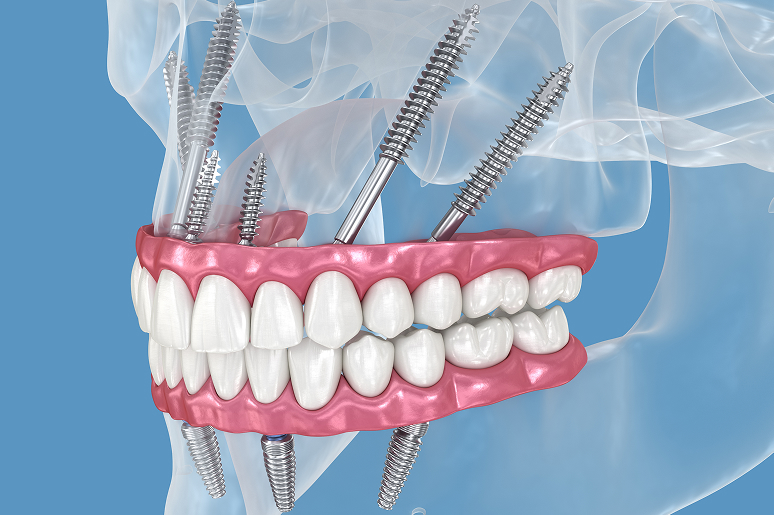
Zygomatic implants bypass the jawbone entirely. They are longer implants that anchor into the zygomatic bone (the cheekbone), which retains its density regardless of dental bone loss. This creates an immediately stable, fixed foundation for a full arch of teeth — without the need for bone grafting or extended waiting periods.
- Longer implants — 30–52.5 mm — anchored in the dense zygomatic arch
- Used for the upper arch when maxillary bone is severely deficient
- Can be combined with conventional implants for hybrid full-arch solutions
- Fixed prosthetic teeth delivered the same day or shortly after surgery
Is This Right for You?
Who Is a Candidate for Zygomatic Implants?
Zygomatic implants are a specialized solution for specific cases involving significant upper jawbone loss. A 3D cone beam CT scan will determine whether your anatomy makes you a candidate — and whether zygomatic implants, standard implants with grafting, or a combination is the right approach.
- Have severe bone loss in the upper jaw (maxilla)
- Were told conventional implants are not possible in your upper arch
- Have been wearing full upper dentures for many years
- Want to avoid months of bone grafting and healing before getting teeth
- Have had previous implants fail due to insufficient bone
- Are missing all upper teeth and want a permanent, fixed restoration
- The zygomatic bone is one of the densest bones in the skull — it rarely resorbs
- Long-term success rates are well-documented in peer-reviewed literature
- No graft means fewer procedures, less total healing time, and lower overall complexity
- Patients receive provisional teeth the same day as surgery
- Advanced 3D surgical planning makes placement precise and predictable
The Process
How Zygomatic Implants Work
A cone beam CT scan maps your jaw, sinus anatomy, and zygomatic bone in precise 3D. Dr. Pasicznyk analyzes your unique anatomy to plan the ideal implant path and determine whether zygomatic implants, a hybrid approach, or another solution is optimal for your case.
Zygomatic implants are placed in a single surgical procedure, typically under IV sedation or general anesthesia. The implants are guided through the upper jaw and anchored securely into the cheekbone. Standard implants may be placed simultaneously in the front of the jaw if sufficient bone is present.
A temporary fixed prosthesis is attached to the implants the same day as surgery. You leave with teeth — not a denture — so function and confidence are restored immediately while your implants fully integrate.
After osseointegration is confirmed — typically 6 months post-surgery — your final, permanent prosthesis is fabricated in our in-house lab and attached. The result is a complete, fixed arch of teeth that looks natural and functions like real teeth.
By anchoring in the cheekbone rather than the jaw, zygomatic implants bypass the need for extensive bone grafting. This eliminates months of additional procedures and waiting — getting you to fixed teeth faster.
Unlike traditional implant timelines that require bone to heal before teeth are attached, zygomatic implants are stable enough the day of surgery to support a full provisional arch. You go home with fixed teeth.
For patients who've been turned away by multiple providers, told their bone loss is too severe, or had prior implant failures, zygomatic implants often represent the last viable path to fixed, permanent teeth.
Common Questions
Zygomatic Implant FAQs
A conventional implant is 8–16 mm long and anchors into the jawbone. A zygomatic implant is 30–52.5 mm long and passes through the upper jaw to anchor in the zygomatic bone (cheekbone). This allows full arch restoration even when the upper jawbone has severely resorbed, eliminating the need for bone grafting in most cases.
Zygomatic implant surgery is a more advanced procedure requiring specialized training and 3D surgical planning. It is typically performed under IV sedation or general anesthesia. Dr. Pasicznyk has training in advanced implant techniques, and every placement is guided by detailed 3D imaging to ensure precision and safety.
Swelling and soreness are expected for the first week. Most patients resume normal activities within 1–2 weeks. A soft diet is required for several months while the implants integrate. Because there is no graft, you avoid the extended recovery often associated with major bone augmentation procedures.
Published long-term data shows survival rates for zygomatic implants exceeding 95% at 10+ years. The zygomatic bone does not resorb the way the jawbone does after tooth loss, making it a stable, durable anchor. With proper hygiene and regular follow-up, zygomatic implants are intended to be a permanent solution.
Zygomatic implants are specific to the upper arch and anchor into the cheekbone. The lower jaw does not have a zygomatic bone equivalent. However, significant lower jawbone loss can often be addressed with standard implants, pterygoid implants, or bone grafting strategies — all of which we evaluate at consultation.
Zygomatic implant treatment is a comprehensive full-arch procedure and is priced accordingly. When compared to multi-stage bone grafting plus conventional implants, the total cost is often similar — with the advantage of fewer procedures and faster results. We provide detailed, transparent pricing at your consultation along with financing options.
Patient Stories
Why patients choose Foundation.
"I was told by two other offices that I couldn't get implants because of severe bone loss. Dr. Pasicznyk found a solution when no one else would. I now have a full smile for the first time in years."
"The entire process from consultation to final restoration was handled in one place. No being shuffled around — Dr. Pasicznyk did it all. The results are genuinely life-changing."
"After wearing dentures for 12 years, I finally have teeth that feel real. I wish I had done this sooner. Everyone at Foundation genuinely cares about you — not just the procedure."
Get Started Today
Fixed Teeth May Be Possible — Even With Severe Bone Loss
A 3D scan and consultation will tell you exactly what your anatomy allows. We'll give you a complete picture of your options, a detailed treatment plan, and transparent pricing — all in one visit.